
Why I chose deep work
The short answer: the complaints people bring me are almost never solved by light surface stroking — and they are almost always tied to what a person does for eight hours a day, five days a week.
I have been in private practice for {{YEARS}} years. In that time I have given {{SESSIONS}} sessions, and around {{CLIENTS}} people come back regularly — some every three weeks, some only during their heavy season. Training and continuing education: {{EDUCATION}}. I deliberately avoid calling myself a generalist: the narrower the focus, the more precise the hands.
I started with classic massage and ran into a ceiling fairly quickly. You apply a standard routine to someone who sits eight hours a day with their shoulders lifted — they feel good for an hour, and by evening everything is back. The reason is that the classic routine covers area: top to bottom, evenly, across the whole back. Tension is not distributed that way. It sits in specific places, and those places are different for an office worker, a cyclist and a new mother.
One more observation that turned my approach around: the pain is almost never where the shortening is. After eight hours at a laptop the short part is not the neck but the suboccipital muscles (mm. suboccipitales) at the base of the skull and pectoralis minor (m. pectoralis minor) at the front, under the collarbone. The shoulder has drifted forward, the shoulder blade has rotated, and the upper trapezius (m. trapezius, descending part) spends the whole day in holding mode. That is the part that aches — but working on it alone buys relief until the next working day.
Deep tissue massage gave me a tool for working with layers: moving slowly through fascial borders, reaching what lies under the superficial musculature, and doing it without forcing the tissue. The word “deep” in the name refers to the depth of the layer, not to the strength of the pressure. That is an important difference, and it is where I begin the conversation with everyone who books for the first time.
Alongside that I learned early where my limits are. Massage is not medical care. I do not make diagnoses and do not prescribe medical procedures: I have neither the right nor the competence. What I do have is the habit of stopping in time and saying, “this one is for a doctor”. There is a separate block below on exactly when.
- One request per session. Not “the whole body in an hour”, but a specific task there is genuinely time for.
- Pressure is discussed out loud. The working level is 6-7 out of 10 by feel. If you can breathe, the pressure is right.
- Honest expectations. If one session will not solve the task, I say so before you pay, not after your third visit.
- Draping throughout. Only the area I am working on is uncovered. The format is the same at the studio and on a visit.
- Homework is two or three movements. Not an hour-long routine that nobody ever does.
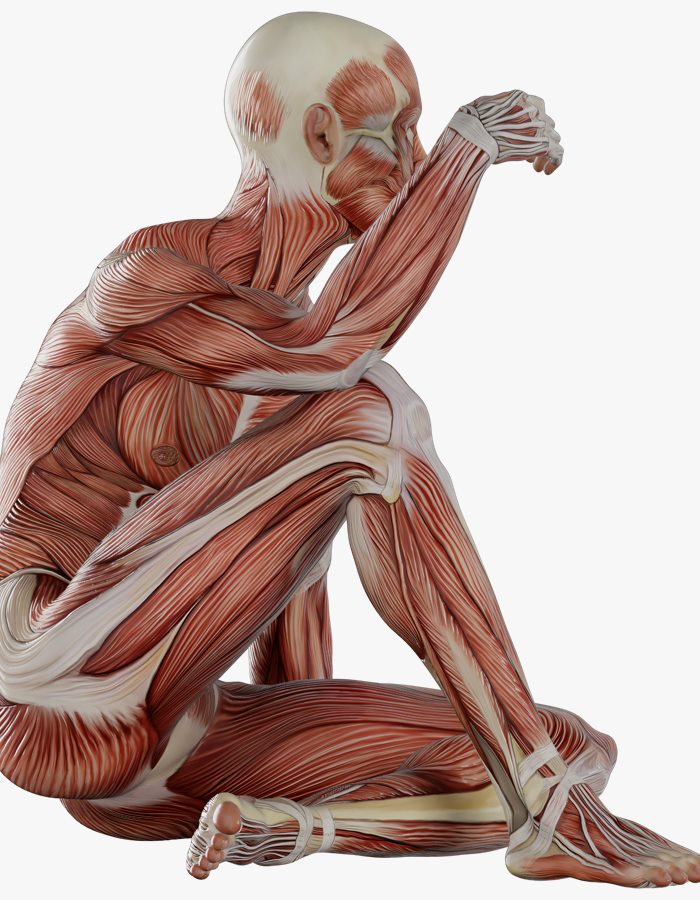
The posture people spend the working day in, only without the skin. You can see the neck and the upper trapezius (m. trapezius, descending part), the deltoid, the erector spinae (m. erector spinae), the glutes and the calf. When the torso is folded forward, the posterior chain holds all of it — and it does that for hours.
- Upper trapezius (m. trapezius, pars descendens)
- Deltoid (m. deltoideus)
- Erector spinae (m. erector spinae)
- Glutes (mm. glutei)
- Gastrocnemius (m. gastrocnemius)
Four things that decide the outcome
This is not a philosophy but a working order of operations. It is the same for an athlete with tight hamstrings and for someone whose neck is “just tired” after a long quarter.
First the history and the movement tests, then the hands
For the first ten to fifteen minutes I do not work with my hands. I ask questions and watch how you move. The questions are simple and specific: when exactly it is unpleasant — in the morning, towards the evening, after load or at rest; what makes it worse, what relieves it; what has changed in your life over the past month. A new job, a new pillow, a new bike, a child you carry on one arm — that is not small talk, that is input data.
Then come short movement tests. I ask you to turn your head both ways and I note the difference. I ask you to bend forward and watch whether the movement comes from the pelvis or only from the lower back. I ask you to raise your arms overhead and see whether the thoracic spine opens or the lower back compensates. It takes five minutes and saves half the session: I can see where the restriction is, not only where it hurts.
- Head rotation to the right and to the left — asymmetry often points to the side you hold your phone or carry your bag on.
- Forward bend — if the lower back folds while the pelvis stays put, the hamstrings are taking part in the “back pain” directly.
- Arms overhead — a restriction here usually comes from the front: the pectorals and the front of the shoulder, not a “tight back”.
- A squat or a step forward — shows how the glutes are working and whether the knee collapses inwards.
- Breathing while lying down — if only the shoulders move on the inhale, the diaphragmatic side has to be addressed separately.
I repeat the same tests at the end of the session. It is the only honest way to show the difference: not “it feels better”, but “rotation to the right went this far, now it goes this far”. If there is no difference, I say that too. Sometimes it appears the next day, sometimes it does not appear at all, and then we change the hypothesis.
I work layer by layer, not “harder”
The main misunderstanding around deep tissue is that it is about force. It is not. It is about speed and the depth of the layer. Tissue cannot be pushed through, it can only be waited for: slow pressure at the border of a layer gives the tissue time to stop defending itself. Fast and strong switches protective tone on, and the muscle ends up denser than it was. That is exactly why the morning after a “powerful” massage is often worse than the day before it.
The working discomfort scale: 6-7 out of 10
Zero is nothing felt at all, ten is you clenching your teeth and holding your breath. The working zone is 6-7: clearly felt, in places right on the spot, but you can breathe evenly and talk. If you can breathe, the pressure is right. If your breathing breaks, you tense up or start to endure it, the pressure is already too much and I take it off. Deep tissue is not “put up with it if it hurts”: pain above the working level does not speed the result up, it cancels it.
In practice it looks like this. I go from the superficial layer inwards rather than straight to the target. First broad slow passes — along the latissimus dorsi (m. latissimus dorsi), across the thoracolumbar fascia. When the surface lets go, the next layer becomes available: the erector spinae (m. erector spinae), the quadratus lumborum (m. quadratus lumborum) beneath them, and only then the deep work around the pelvis where the piriformis (m. piriformis) sits. Jumping straight to the target through a defended surface does not work: you run into tone and cause pain with nothing to show for it.
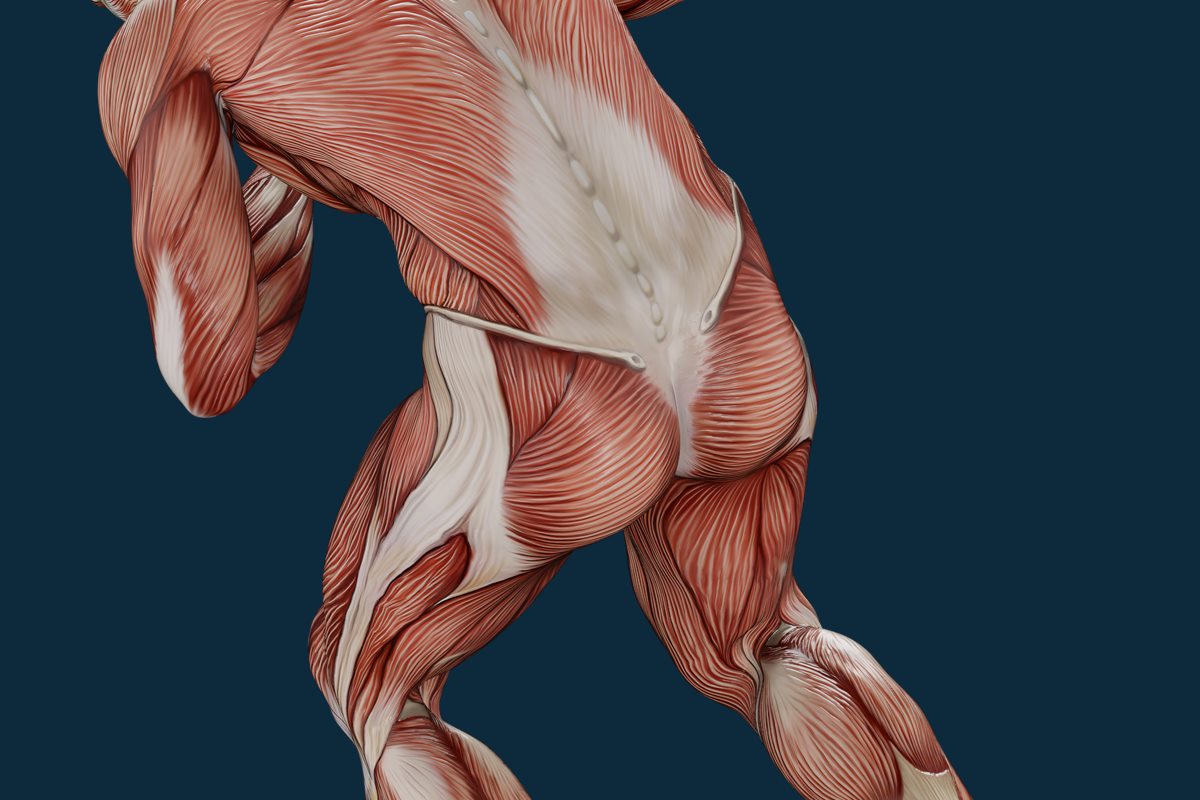
Forward bend, seen from behind. The thoracolumbar fascia is under tension and visible in full — through it the lower back is connected to the lats, the glutes and the hamstrings. It is one of the reasons I almost never work on a lower back in isolation: the pull can come from below, from the pelvis and the thigh.
- Thoracolumbar fascia (fascia thoracolumbalis)
- Latissimus dorsi (m. latissimus dorsi)
- Glutes (mm. glutei)
- Hamstrings (mm. ischiocrurales)
A separate word on trigger points. A dense spot in a muscle that produces a referred sensation away from itself is a useful thing in the work, but not a universal key. I do not burn points out one by one until they disappear: a hold within a reasonable range, attention to the breath, then movement of that area. A point without movement afterwards comes back almost every time.
A muscle is not “tight” out of spite. It is holding what you ask it to hold for eight hours a day. A session removes the consequence; coming to terms with the cause is your part of the work, and it is not a hard one.
Ale
Homework instead of dependence on sessions
If someone comes to me once a week for years and cannot manage without it, I have done my job badly. The normal scenario is a different one: a series of sessions for a specific task, a look at the everyday causes alongside it, then a maintenance rhythm every three to six weeks or as needed. Some people need no maintenance at all, and that is the best possible outcome.
So at the end of every session you get homework. Not a forty-minute routine — nobody does those, and I know it perfectly well. Two or three movements of a minute and a half each, tied to an everyday anchor: after the shower, before bed, between calls. Plus one or two adjustments to your environment: monitor height, the side you carry your bag on, your pillow, your position in the saddle.
| What people come with | What we do in the session | What stays with you |
|---|---|---|
| Neck and shoulders by evening after a day at the laptop | Upper trapezius, the suboccipitals, the front of the shoulder and pectoralis minor — the one pulling the shoulder forward | A doorway chest opener and a gentle chin movement, plus the monitor raised to eye level |
| The lower back “pulls” after a day of sitting | Erector spinae, quadratus lumborum, glutes and hamstrings — as a single chain | Two movements for pelvic mobility and an agreement to stand up once an hour, even if only for a minute |
| Heavy legs after running or the gym | Hamstrings, gastrocnemius (m. gastrocnemius) and soleus (m. soleus), glutes, work on the tensor fasciae latae (m. tensor fasciae latae) and vastus lateralis | A warm-up before the run instead of static stretching on cold muscle, and an honest agreement on volume: no more than ten percent added per week |
| Limited torso rotation, “I cannot twist” | Thoracic spine, the lats, the obliques and serratus anterior (m. serratus anterior) | Seated rotation and breathing into the lower ribs — a minute in the morning, a minute in the evening |
If the homework does not get done, that is no disaster — but then we discuss it honestly and swap it for something that genuinely fits into your week. One movement that actually happens beats five that were written down and forgotten.
When I send you to a doctor
This is not a formal disclaimer at the bottom of the page, it is a working part of the method. Massage is not medical care: I do not make diagnoses, do not prescribe medication or procedures, and do not override what a doctor has prescribed. Some conditions simply fall outside my competence, and in those cases the session is not postponed “just in case” — it does not happen, and you go to a specialist.
- Acute pain that came on suddenly and does not settle at rest, especially at night.
- A shooting pain with loss of sensation, numbness, tingling, weakness in an arm or a leg — that is a conversation with a doctor, not with me.
- A fresh injury: suspected fracture, tear, dislocation, a strain in its first days, swelling and bruising.
- Fever, a respiratory infection, any acute inflammation — we cancel without questions and without any loss of the deposit.
- Thrombosis or thrombophlebitis, pronounced varicose veins in the working area — that area is excluded completely.
- Cancer — work is possible only in agreement with your treating doctor and within the limits they allow.
- Uncontrolled hypertension, anticoagulant therapy — a conversation with your doctor first.
- Skin infections and damaged skin in the working area — we wait for the skin to recover.
- Pregnancy — this needs a therapist with specific training; it is a separate competence.
- Being under the influence of alcohol — the session does not take place, no exceptions.
There is a softer version of that line as well: when there is no change at all after two or three sessions. That is a signal that the hypothesis is wrong and the cause most likely lies outside my area of responsibility. In that case I say plainly that this is no longer for me, and I do not sell a fourth session. The full list of limitations is on the questions and answers page, where the borderline cases are covered too.
The boundaries of a session — on both sides
My work is strictly therapeutic. The format is the same at the studio and on a visit: draped with a sheet or fully clothed, only the working area uncovered, intimate services excluded and not up for discussion. Either side can end the session at any moment — you or I, without giving a reason. That is not strictness, it is the working condition under which both people feel at ease.
Training, equipment, principles
Three lists without adjectives. I show documents on request — at the first session, at the studio or on a visit; that is a normal question, not a sign of distrust.
Training and continuing education
- Core training and professional certificates: {{EDUCATION}}. Originals shown on request.
- A dedicated course in deep tissue technique: layer-by-layer work, the speed of pressure, working with fascial borders.
- Myofascial release and trigger point therapy — as tools inside a session, not as a separate piece of magic sold on its own.
- Sports and recovery work: preparing for load and recovering afterwards, work with the posterior chain.
- Applied anatomy and biomechanics: without them, layer-by-layer work turns into guesswork.
- First aid and a review of contraindications — updated regularly, because this is the part where a mistake costs the most.
- Regular case discussions with colleagues and supervision: an outside eye sees what your own hands have stopped noticing.
Equipment and supplies
- A professional table with a rigid frame and adjustable height. A soft surface absorbs pressure — deep work on a sofa is physically impossible.
- A folding portable table 70 cm (28 in) wide: it fits a room of about 2 × 2.5 m and takes five minutes to set up.
- A fresh set of linen for every client — sheet, cover, pillowcase. On a visit it is unsealed in front of you.
- Unscented oil on a hypoallergenic base. If you react to cosmetics I choose a neutral option — tell me in advance.
- Bolsters and cushions under the ankles, the abdomen and the chest: a comfortable position should not cost you any effort.
- A table warmer and a warm blanket: warm tissue is more workable, and that is not comfort for its own sake but a working condition.
- Hands and surfaces disinfected between clients, short nails, fresh clothing for every visit.
- A quiet timer instead of glances at the clock — I keep the time, not you.
Working principles
- One request per session. Two areas means 90 minutes, not “we will fit everything into an hour”.
- Pressure is discussed out loud at the start and as we go. There is no need to endure it in silence: that makes the result worse, not closer.
- I do not make diagnoses, do not give medical instructions, and do not cancel or comment on what your doctor has prescribed.
- I say no when a session will not help: with contraindications, in an acute condition, and when there is no change after two or three meetings.
- Therapeutic massage only. Draped with a sheet or fully clothed, one working area uncovered, intimate services excluded.
- Both sides have the right to end the session, at any moment and without explanation.
- I name the price before booking, together with the travel surcharge. Nothing is recalculated on the doorstep.
- Everything you tell me about your health, your work and your family stays between us. No stories about clients — not even without names.
- After the session you get a short plan for the next twenty-four hours. What you can do, what is better postponed, what to expect tomorrow.
Anatomy instead of intuition
I show these anatomical renders during the session itself — explaining on them is easier than in words. They are also the basis of the interactive muscle atlas: it becomes clear where the pull comes from and why we work somewhere other than where it hurts.
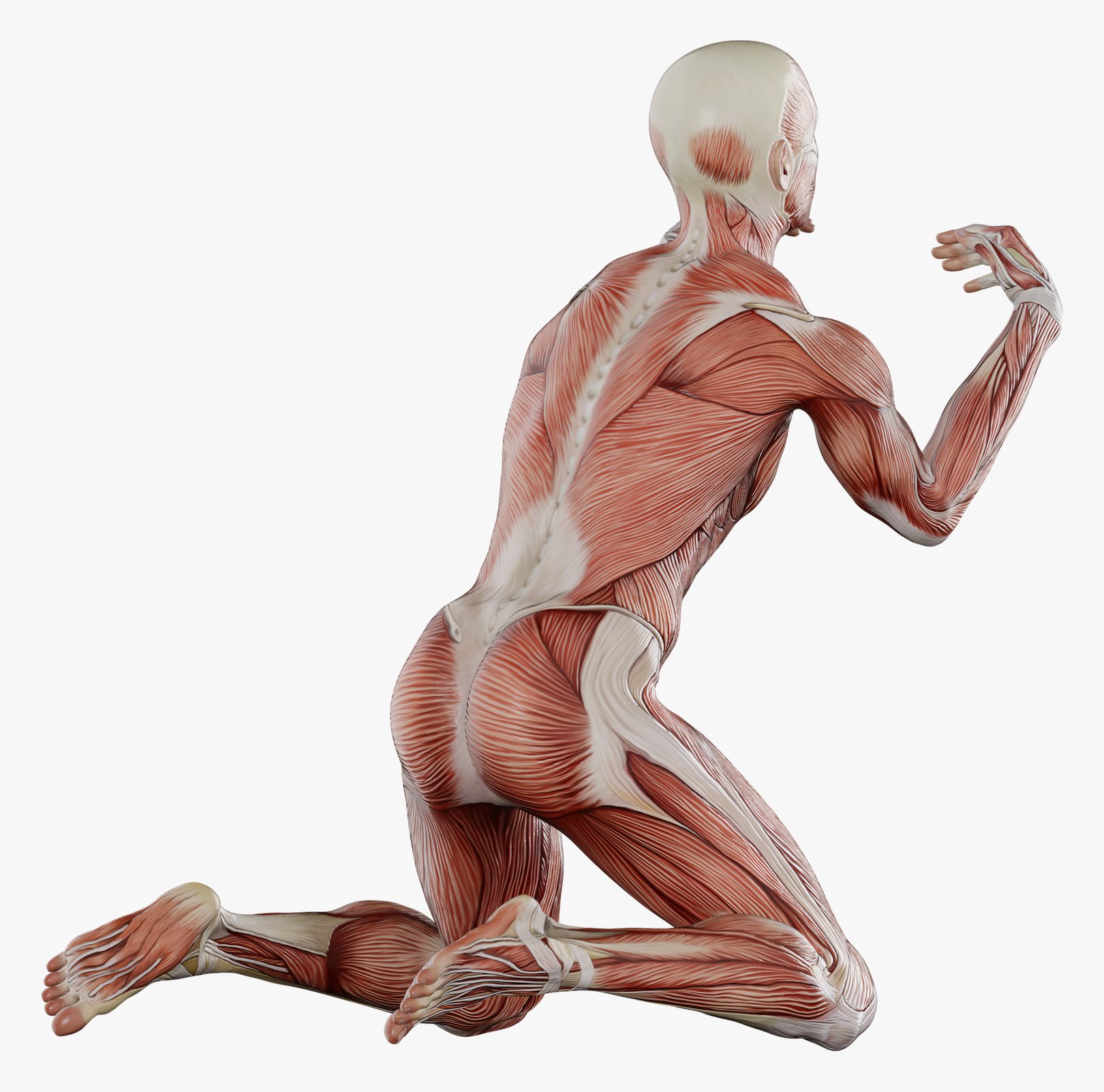
The posterior chain in rotation
A figure on one knee, torso turned. You can see the trapezius (m. trapezius), the deltoid, the latissimus dorsi (m. latissimus dorsi), the erector spinae, the glutes and the iliotibial band (ITB) along the outside of the thigh. The band is fascia, not muscle: you cannot “stretch” it by hand, but you can work on the tensor fasciae latae (m. tensor fasciae latae) and the vastus lateralis, which weave into it.
- Trapezius (m. trapezius)
- Deltoid (m. deltoideus)
- Latissimus dorsi (m. latissimus dorsi)
- Erector spinae (m. erector spinae)
- Glutes (mm. glutei)
- Iliotibial band (tractus iliotibialis)
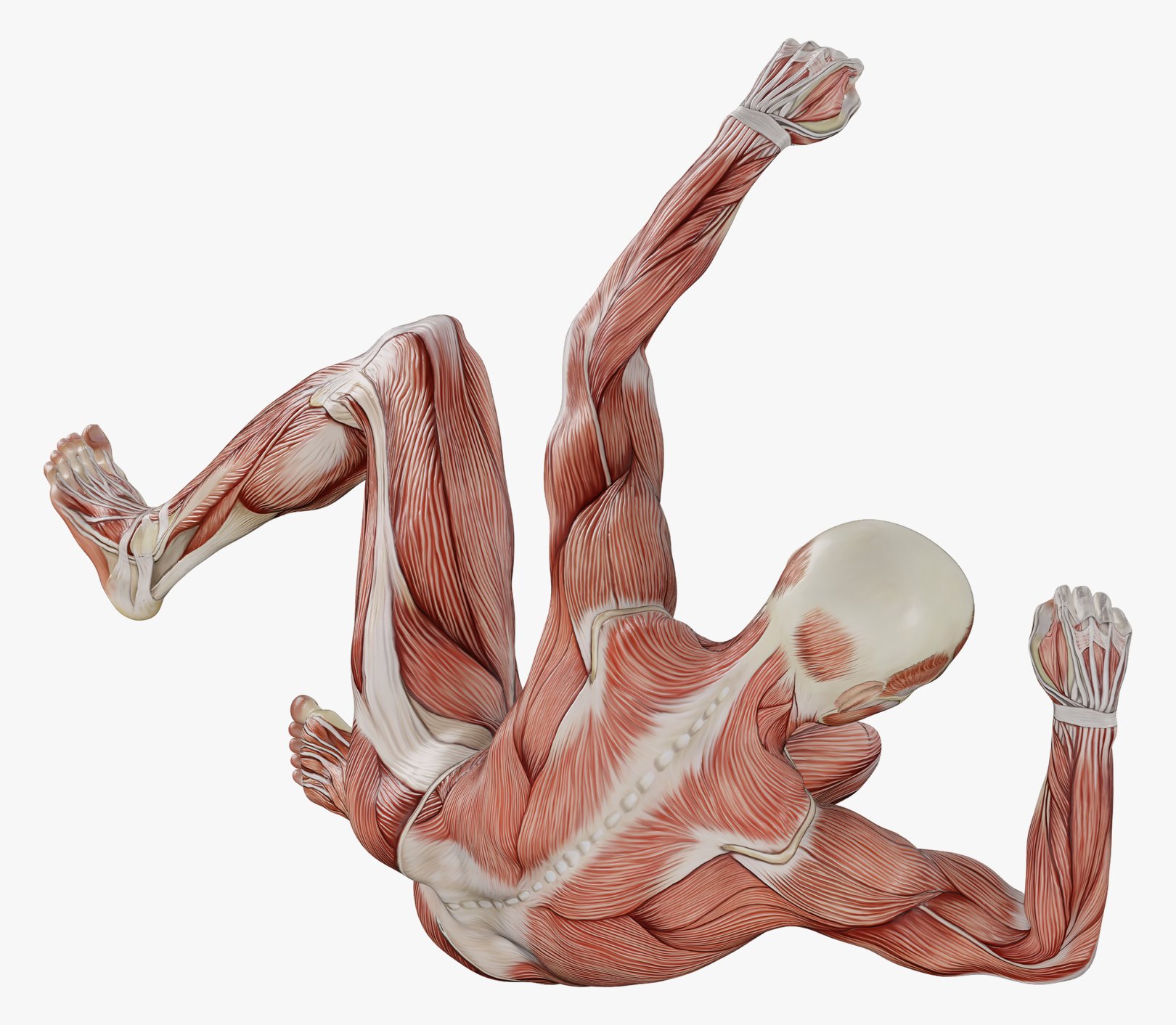
Rotation while lying down, the back up close
Trapezius, lats, erector spinae and glutes in a single frame. In rotation you can see that the back does not work in sheets from top to bottom but in diagonals — and the hands follow those same diagonals.
- Trapezius (m. trapezius)
- Latissimus dorsi (m. latissimus dorsi)
- Erector spinae (m. erector spinae)
- Glutes (mm. glutei)
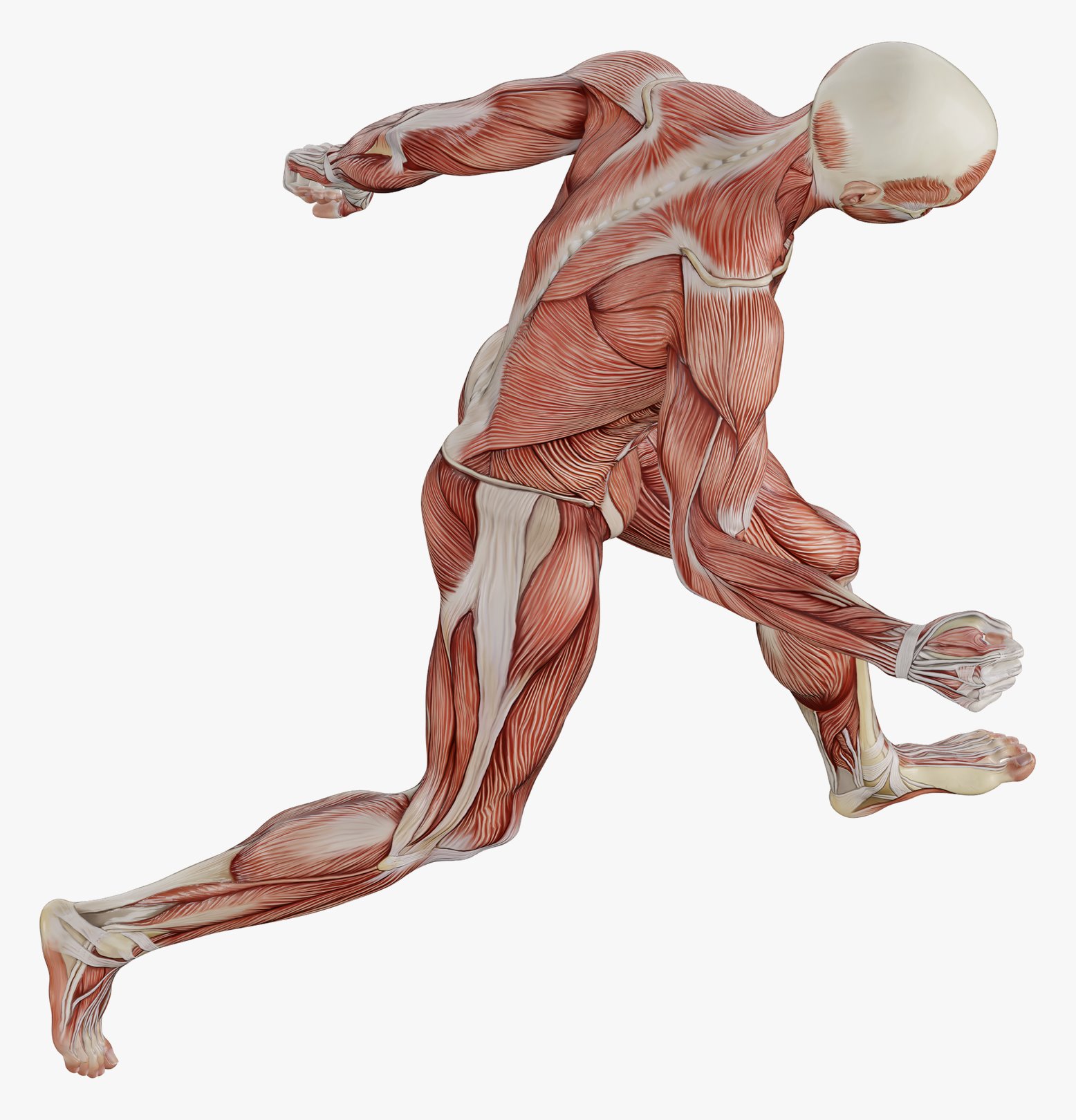
Running stride
Glutes, hamstrings, the calf muscle and the Achilles tendon. A frame I like for conversations with runners: a “tight calf” is almost always part of a chain that begins higher up, at the pelvis.
- Glutes (mm. glutei)
- Hamstrings (mm. ischiocrurales)
- Gastrocnemius (m. gastrocnemius)
- Achilles tendon (tendo calcaneus)
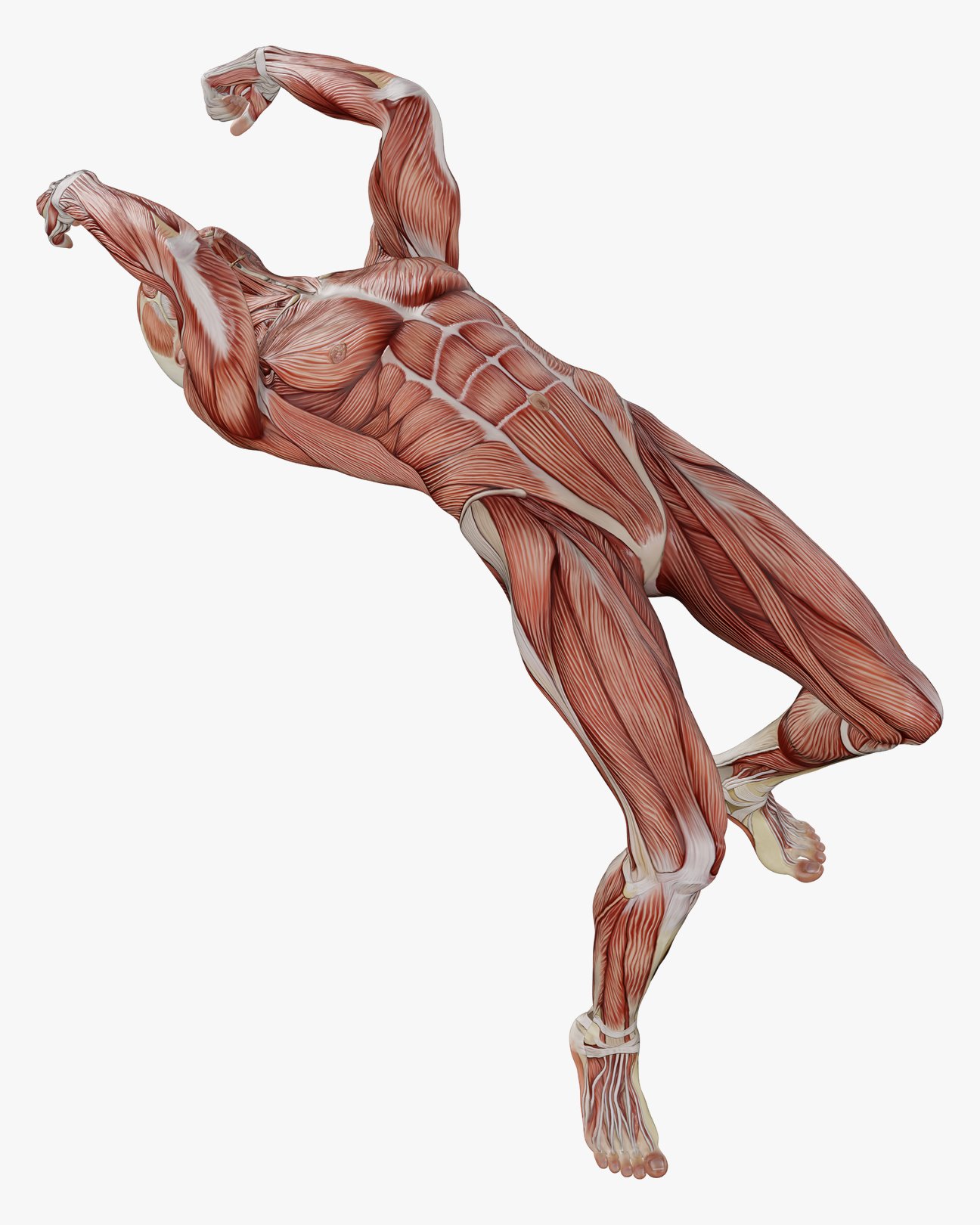
The front of the body
Pectoralis major, rectus abdominis, the obliques, quadriceps, biceps brachii. The half of the body nobody remembers when their back hurts: a shoulder that has drifted forward pulls from the front, while the ache turns up behind.
- Pectoralis major (m. pectoralis major)
- Rectus abdominis (m. rectus abdominis)
- External oblique (m. obliquus externus abdominis)
- Quadriceps (m. quadriceps femoris)
- Biceps brachii (m. biceps brachii)
How it looks from the client side
Sample reviews — replace them with real ones
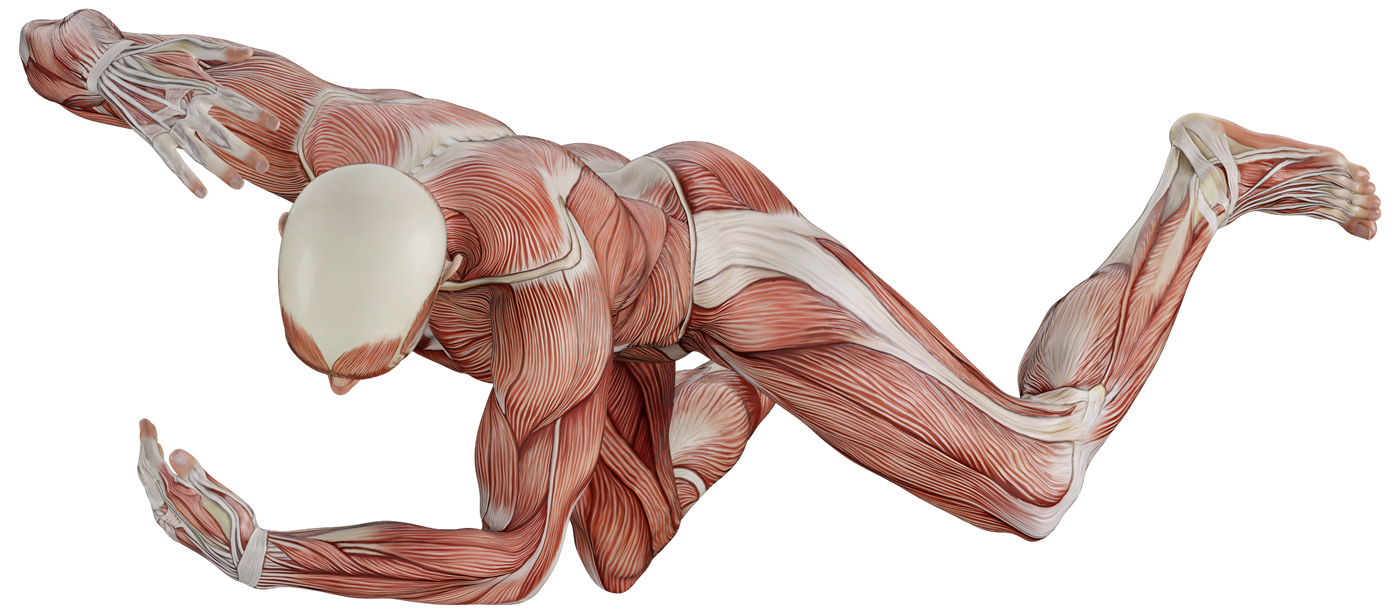
Lying face down is the basic position for deep work on the back: the muscle is relaxed and does not push back against the forearm. Latissimus dorsi (m. latissimus dorsi) · Glutes (mm. glutei) · Hamstrings (mm. ischiocrurales)
Let us start with a conversation, not a ten-session package
Write two or three sentences about what is bothering you and how long it has been going on. I will answer honestly: I can help, I cannot help, or this is a case for a doctor first. If I can help, I will suggest a format and the nearest slot within 09:00–21:00. Reach me at {{PHONE}}, {{WHATSAPP}}, {{TELEGRAM}}, {{EMAIL}}.