E-mail
{{EMAIL}}
Phone
{{PHONE}}
Working hours
09:00–21:00
Skip to content

Questions and answers

Everything people usually ask before booking is collected here: how a session is built, what to prepare for a mobile visit, who deep tissue massage is not suitable for, and how the money works. I answer in full and the same way for everyone — so that you can decide in advance rather than on the doorstep.

Before you book

About the session

What actually happens on the table, what counts as working pressure, and what to expect the next day.

Classic massage works broadly and close to the surface: long gliding strokes over a large area, with the aim of lowering overall tone and calming the nervous system. Deep tissue massage is targeted. Before the work starts I choose a specific layer and a specific muscle: not “the whole back”, but, say, the erector spinae (m. erector spinae) along the lumbar segment and quadratus lumborum (QL) under the lowest rib. Then comes slow pressure along or across the fibres, and a pause until the tissue lets go by itself. “Strong massage” is about how hard you press; deep tissue is about where you press and how slowly. Force without an address gives you bruises and guarding, not a change in range of motion.
The working range is 6 to 7 out of 10 on the discomfort scale: clearly felt, a pulling sensation, you want to breathe out — but your breathing stays even and you can answer in sentences rather than single words. A simple rule of thumb: if you can still breathe, the pressure is right. Anything above eight works against us: the muscle answers with reflex tone, the layer closes, and there is no reaching it any more. Deep tissue is not “put up with it if it hurts”. I ask about the scale out loud several times during a session, and “ease off” is a normal working answer, not a spoiled session.
Sixty minutes covers one area and one request: neck and shoulders (upper back), or the lower back, or the legs after a hard load. Ninety minutes is the standard format for a long-standing problem: there is time for the area at fault and for the neighbouring structures holding it. One hundred and twenty minutes is for several complaints at once, or for a body that has not been worked on in a long time: we cover the whole posterior chain and add the front of the body. There is also a thirty-minute express session ({{PRICE_EXPRESS}}) — that is focused work on a single area between other things, not a “small full massage”. If you are unsure, describe the complaint in a message and I will suggest a length and explain why that one.

First five to ten minutes of conversation: where it pulls, how long it has been going on, what makes it worse and what relieves it, any injuries and surgeries, any medication you take. Then short movement tests — bending, rotating, raising an arm: I need to see where the range breaks off. Then palpation: I find that exact area with my hands and check whether it answers with the pain you recognize. Only after that does the work begin — from the superficial layers to the deep ones, with constant checks against the scale. At the end we repeat the same tests: the difference in movement before and after is the objective part of the result, unlike the feeling of “a bit better”.
This is delayed soreness, familiar to anyone who has gone back to training after a break. The normal version: a dull, diffuse sensation in the areas we worked, arriving 8 to 24 hours later, lasting up to two days, easing with warmth, a shower and calm movement. The abnormal version: sharp pinpoint pain that grows day by day, extensive bruising, numbness or tingling, soreness lasting more than three days. In that case write to me — we will work out what was too much and adjust the pressure next time. The mechanism here is exactly the same as after a first workout in a new gym: an ordinary tissue response to an unfamiliar mechanical load, and nothing beyond that.
It depends on how old the problem is, not on how intense it feels. A fresh overload after moving house, a renovation or an unfamiliar workout is usually sorted out in one or two sessions. A pattern that has lived with you for six months or longer needs a series: four to six sessions a week to ten days apart, then maintenance every three to six weeks. An honest criterion: if after three sessions neither the range of motion nor the character of the pain has changed, this is not the right tool, and I will say so directly instead of selling you a fourth one. For series there are the 250€ and 450€ packages — they cost less than single sessions and keep the interval disciplined.
How it works

Mobile visits and logistics

Home, hotel, office: what to prepare, how much room is needed, how the surcharges work and where the boundaries are.

The minimum: a clear patch of floor roughly two by two and a half metres, so that the table can be reached from three sides — I work standing and move around it. A warm room with no draughts: on the table you lie almost motionless and cool down faster than you would think. One large towel in case it is needed. Pets are better off in another room — not on principle, but because a cat on your lower back interrupts the work for both of us. A shower is more convenient before the session than after. Everything else — table, linen, bolsters, oil — I bring with me. Allow ten minutes for setting up the table and for the conversation.
Yes, a professional folding table, about two metres long and 70 cm (28 in) wide; it sets up almost silently, with no drilling and no rearranging of your furniture. If the room is small, tell me in advance — part of the work can be done seated on a stable chair, and for neck and shoulders (upper back), the upper trapezius (m. trapezius, descending part) and the suboccipital muscles (mm. suboccipitales) that is a full format, not a compromise. What really does not work is laying you out on a bed or sofa: a soft base sinks, the pressure disappears into the mattress, and the deep layers stay out of reach.
Yes, a hotel visit is a separate format with its own surcharge of 100€. The venue rules matter more than my preferences here, so please ask the front desk to add my name (Ale) to the list of expected guests: that removes any questions at the entrance. The room needs the same clear patch of floor; the bed is unsuitable for the same reason as at home. Late slots for guests arriving off a flight are routine: I work within 09:00–21:00, and anything outside those hours is agreed the day before and charged at the {{PRICE_NIGHT}} rate. With international guests I am comfortable working in English — complaints, the pressure scale and the safety rules are all discussed in a language you understand. Details are on the mobile visits page.

The surcharge depends on the zone and nothing else: central Barcelona — no extra charge, nearer and outer districts (Area Metropolitana de Barcelona) — 100€, hotels and serviced apartments — 100€, the outskirts are quoted separately and booked at least a day ahead. It does not depend on traffic, on which floor you live on, or on how long it took me to find your entrance. I name the exact amount before booking — nothing is recalculated on the doorstep. For the far zones I mostly take long sessions: at 90 and 120 minutes the travel is worth it for both sides. The full zone map is on the home and hotel visits page.
A format for couples exists (140€), but it is worth understanding the mechanics: there is one therapist, so the sessions run one after the other rather than at the same time — first one person, then the other. Allow double the time. Another adult being in the apartment — a relative, a partner, a flatmate — is entirely normal and does not get in the way. If it makes you more comfortable, let them stay: it is your home and your rules of comfort. A child or a pet is better occupied in another room, otherwise there will be more interruptions than work.
The work is done under a sheet: only the area I am working on right now is uncovered, everything else stays draped. You keep your underwear on — that is normal and does not get in the way of anything. For neck, shoulders and arms we can work straight through a loose T-shirt. Let me put this plainly so that nothing is left unsaid: I provide strictly therapeutic massage, and any intimate services are entirely excluded; questions on that subject end the conversation before the visit, and end the session if they come up on site. And symmetrically: either side may stop the session at any moment without giving a reason. The time already worked is paid for, the remainder is not.
Health

Health and safety

Massage is not medical care. Nobody here makes diagnoses or prescribes medication. These answers are here so you can tell when a session is appropriate and when you need a doctor first.

A session is not carried out with fever or a respiratory infection, acute inflammation, thrombosis or thrombophlebitis, skin infections and skin damage in the working area, fresh injuries and fractures, uncontrolled high blood pressure, while taking anticoagulants, or under the influence of alcohol. A separate group covers conditions where a doctor has to decide: a cancer diagnosis (I work only with the agreement of your treating doctor), pronounced varicose veins in the working area, pregnancy (that is a job for a specialist in the field; I do not take those sessions), osteoporosis, recent surgery and fresh scars. The full list is in the contraindications section below. Tell me about chronic conditions and medication before booking, not once you are on the table.
First, what does not happen: a disc is not “put back” by hand, and I cannot and will not promise you a changed picture on the scan. What is genuinely possible is work with the musculature around it — the erector spinae, quadratus lumborum, the glutes and piriformis (m. piriformis), which in this situation almost always sit in protective tone and add their own pain on top of the original problem. There is one condition: no nerve root symptoms. If there is numbness, tingling, weakness in the leg, or a sudden shooting episode after which the limb obeys you less well — see a doctor first and book the session once they agree. Bring the report if you have one: it speeds the conversation up.
Thrombosis and thrombophlebitis are an unconditional stop, with no exceptions and no “gently around the edge”: mechanical work in that situation is dangerous. Varicose veins in the working area mean we do not go over that area at all — we bypass the legs and work higher up, on the glutes and lower back for instance, if nothing else rules it out. Spider veins on their own are not a contraindication, but the pressure over them is reduced. If you are under the care of a vascular surgeon or a phlebologist, ask them directly about deep tissue massage of the lower limbs and pass their answer on to me. On this question their word outranks my experience.

No, and that is a matter of principle rather than caution for its own sake. Massage during pregnancy is a separate specialization with its own positioning, its own limits on areas and pressure, and its own training. My work is deep tissue, and I will say honestly that this is not my field. Go to a prenatal massage specialist, and be sure to agree the sessions with the doctor managing your pregnancy. The same applies to the early postpartum period: when it is safe to return to deep work is decided by a doctor, not by a massage therapist and not by a timeline found online.
Any medication that affects blood clotting: deep work is not carried out while you are on anticoagulants — the risk of haematomas is too high. Uncontrolled hypertension: if your blood pressure swings and treatment is not holding it, the session waits until it is stable. Diabetes, especially with neuropathy: sensitivity is reduced, which means your discomfort scale stops being a reliable guide, and I choose pressure conservatively. Hormone therapy, recent general anaesthesia, a pacemaker, epilepsy, and any autoimmune condition in a flare. This is not a questionnaire out of politeness — the answers decide the pressure, the choice of areas, and whether the session happens at all.
When there is numbness, tingling, weakness in an arm or a leg, or loss of sensation; when a limb obeys you poorly after a shooting episode; with a fresh injury, swelling, redness and local heat; with fever and signs of inflammation; with pain that wakes you at night and does not change with position; with unexplained weight loss; with dizziness and vision problems together with neck pain. Not one of these items is dealt with by hand. Massage is not medical care: I do not make diagnoses and I do not prescribe medication. If a case is not mine, I will say so straight away and point you towards the right specialist — that is part of the work, not a refusal to do it.
Payment and booking

Money and booking

Transparent rules: what it costs, how to book, what happens if you cancel, and what happens if the format turns out not to suit you.

The price depends on the length and on the place: 60 minutes — 55€, 90 minutes — 85€, 120 minutes — 105€, a 30-minute express session — {{PRICE_EXPRESS}}. A mobile visit adds the zone surcharge: 100€ for the districts, 100€ for hotels, {{PRICE_NIGHT}} for late hours outside 09:00–21:00. Technique does not affect the price: myofascial release, trigger point therapy and sports and recovery work are tools inside one session, not separate price lists. The full table with packages is on the pricing page.
The fastest route is a message on {{WHATSAPP}} or {{TELEGRAM}} with three lines: what is bothering you, where you are, and when suits you. A call to {{PHONE}}, an email to {{EMAIL}} and the form on the contacts page all work too. I reply during working hours, 09:00–21:00. On timing: the studio at Balmes 200 and central Barcelona can often be booked the same day, and the nearer districts too if a slot is free, while the far zones and the outskirts are better booked a day ahead. Weekday evening slots go first — if you need a time after work, write early.
Rescheduling in advance is free and needs no explanation; the calendar is a living thing, and an honest message always beats silence. Far zones, the outskirts and late slots are confirmed with a small travel deposit: it covers the journey, not the session, and is deducted from the final amount. If you cancel at the last moment that deposit is not refunded — the slot had already been taken off the calendar and not offered to anyone else; the cost of the session itself is of course not charged. If you are late, the session still ends at the scheduled time: the next address is already in the calendar. If I am late, I add the missing minutes or adjust the price.

Payment after the session — cash or bank transfer; I send confirmation of payment to {{EMAIL}} on request. The 250€ and 450€ packages make sense in exactly one case: when we have agreed on a series, meaning the problem is older than six months and needs a regular interval. If yours is a one-off overload after moving house or running a marathon, there is no need to buy a package, and I will say so myself. A package does not expire in a week; I state the validity period when you buy it, and sessions from a package can be passed on to someone else if you let me know in advance.
Yes, a gift certificate for any length is arranged by message — tell me the format and the recipient’s name, and I will send a version to print or to forward electronically. One request: do not give deep tissue massage to someone who did not ask for it and who is wary of being touched. In that situation the gift is better framed as “a certificate for a session, with the length and the technique up to you” — then the recipient can start with a gentler format or with an express session. When they book, I will in any case ask the recipient the same health questions I ask everyone else.
If it becomes clear during the conversation before booking that you need a doctor or another specialist, I will say so immediately and will not take the booking. If it comes to light on site — for example, the assessment reveals a contraindication you did not know about — the session is not carried out and is not charged; the travel is paid for in that case, because the journey has already happened. If the pressure or the pace did not suit you, say so during the session: almost everything can be adjusted as we go. And if afterwards you feel the work was not the right one, write to me honestly. That is more useful for both of us than quietly not coming back.
Safety

Contraindications

Deep tissue massage is a strong mechanical intervention, and it has honest limits. I ask you to read this list before booking. Tell me about chronic conditions, recent surgery and any medication in advance: the pressure, the choice of areas and whether the session happens at all depend on it.

The session is not carried out

  • Fever, respiratory infection and any acute infectious condition — until you have fully recovered.
  • Acute inflammation, including local signs: redness, swelling, local heat in the working area.
  • Thrombosis and thrombophlebitis — an unconditional ban on mechanical work.
  • Skin infections, rashes, open wounds and burns in the working area.
  • Fresh injuries, fractures, ligament and muscle tears, haematomas in the acute phase.
  • Uncontrolled hypertension: blood pressure swings and treatment is not holding it.
  • Anticoagulants and other medication affecting blood clotting — the risk of extensive haematomas.
  • Alcohol intoxication, or the state after a significant dose of painkillers: the discomfort scale stops working.
  • Acute pain of unclear origin, numbness, loss of sensation, a shooting episode with weakness in a limb — a doctor first.

Only with a doctor’s agreement or with a modified protocol

  • A cancer diagnosis at any stage, remission included — I work solely with the agreement of your treating doctor.
  • Pregnancy and the early postpartum period — you need a prenatal massage specialist; I do not take those sessions.
  • Varicose veins: we bypass that area and work higher up and on other regions.
  • Osteoporosis and increased bone fragility — the pressure is reduced and some techniques are excluded.
  • Diabetes, especially with neuropathy: sensitivity is reduced and your scale stops being a reliable guide.
  • Recent surgery, fresh and keloid scars — the surgeon decides when deep work may resume.
  • Disc herniation and bulges without nerve root symptoms — we work with the musculature around it, not with the disc.
  • Autoimmune and rheumatological conditions in a flare.
  • Epilepsy, a pacemaker, recent general anaesthesia, hormone therapy — let me know before booking.
  • Age: I work with teenagers only in the presence of a parent and with a paediatrician’s agreement.

Massage is not medical care: nobody here makes diagnoses, prescribes medication or cancels what your doctor has prescribed. This list does not replace a consultation and does not cover every possible situation — if you are in doubt, ask your own doctor directly about deep tissue massage and pass their answer on to me. If you are already on the table and something has changed in how you feel, say so right away: stopping in the middle of a session is a normal decision, not a ruined session.
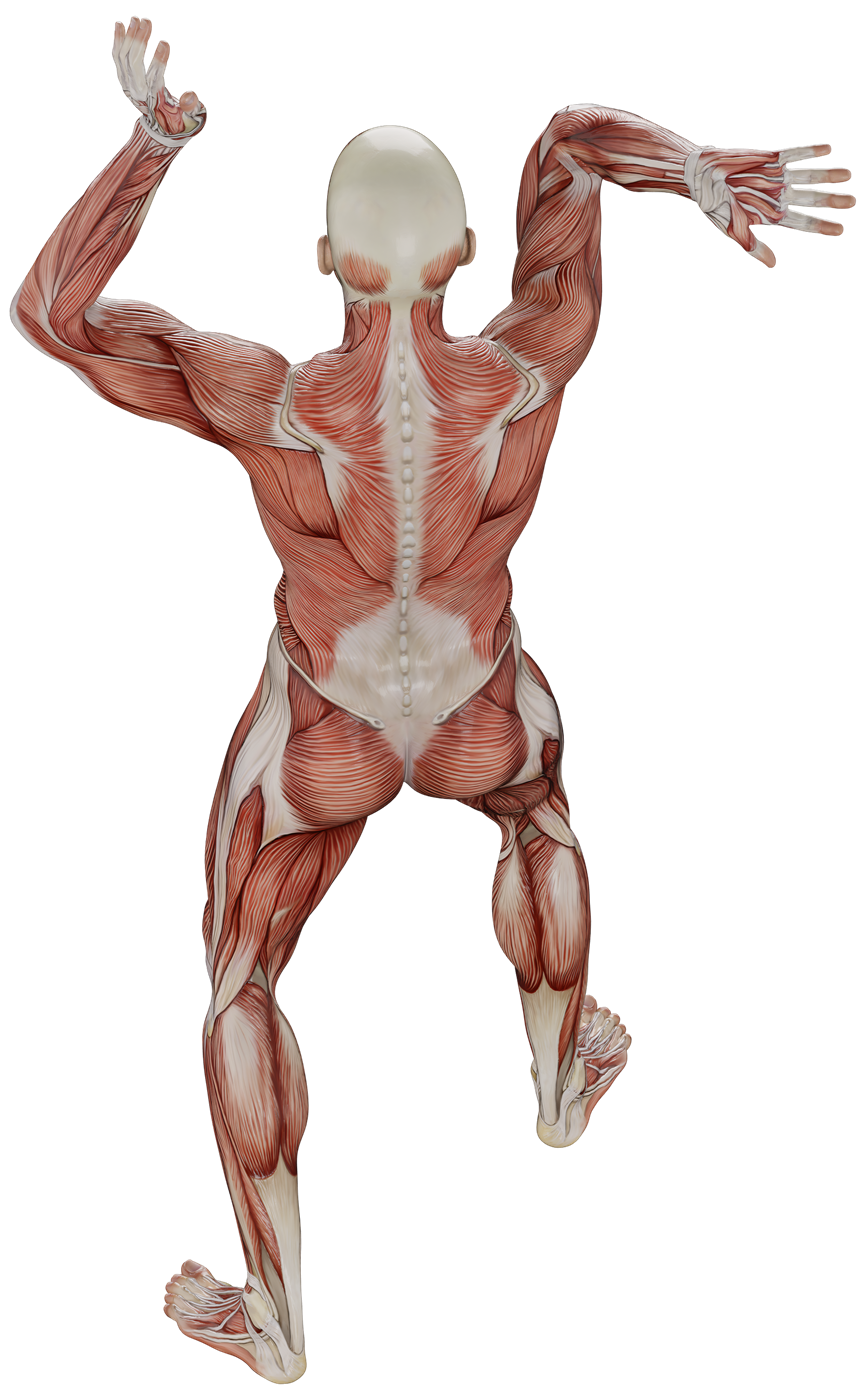
Anatomical 3D render: full-height skinless figure seen from behind, arms raised overhead

The whole posterior chain in a single frame: from the trapezius down to the calves. It shows why the lower back rarely hurts on its own. Trapezius (m. trapezius) · Deltoid (m. deltoideus) · Latissimus dorsi (m. latissimus dorsi) · Erector spinae (m. erector spinae)

Did not find your question?

Write it in your own words — I will answer before you book and with no obligation. If the case is not mine, I will say so plainly and point you towards the right specialist. Sessions at the studio at Balmes 200, plus visits to homes, hotels and offices — districts Area Metropolitana de Barcelona, working hours 09:00–21:00.

Call WhatsApp Book