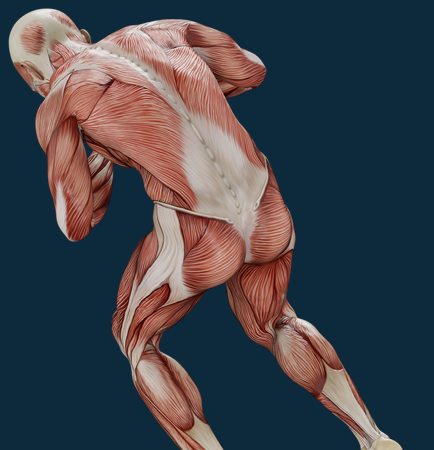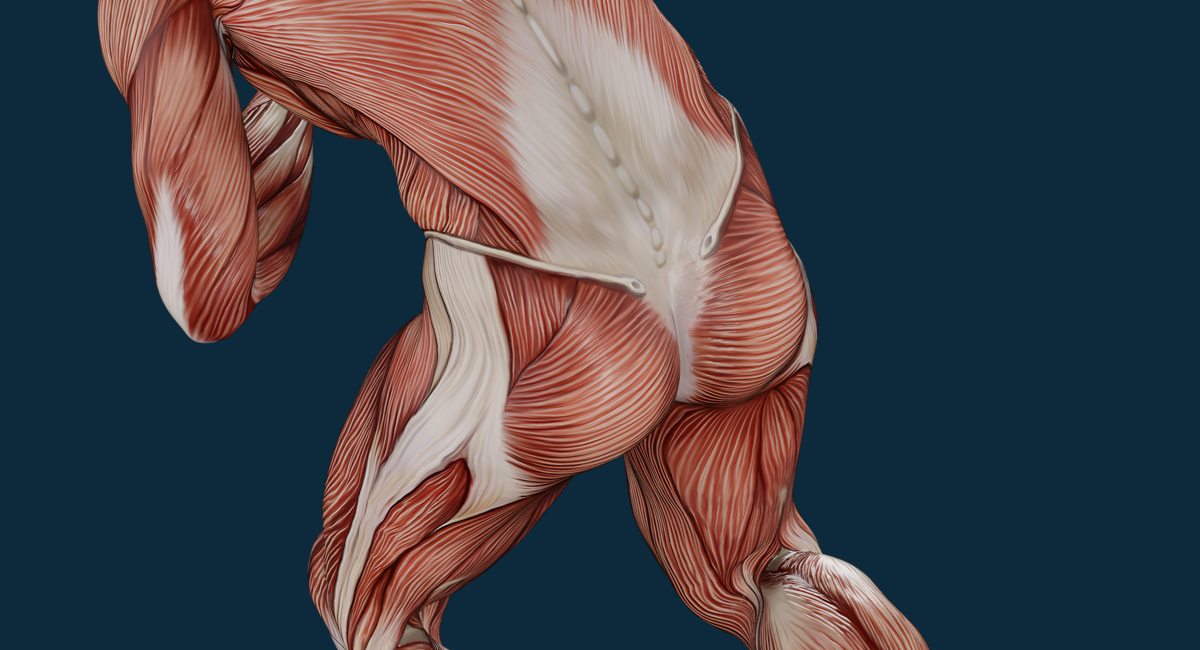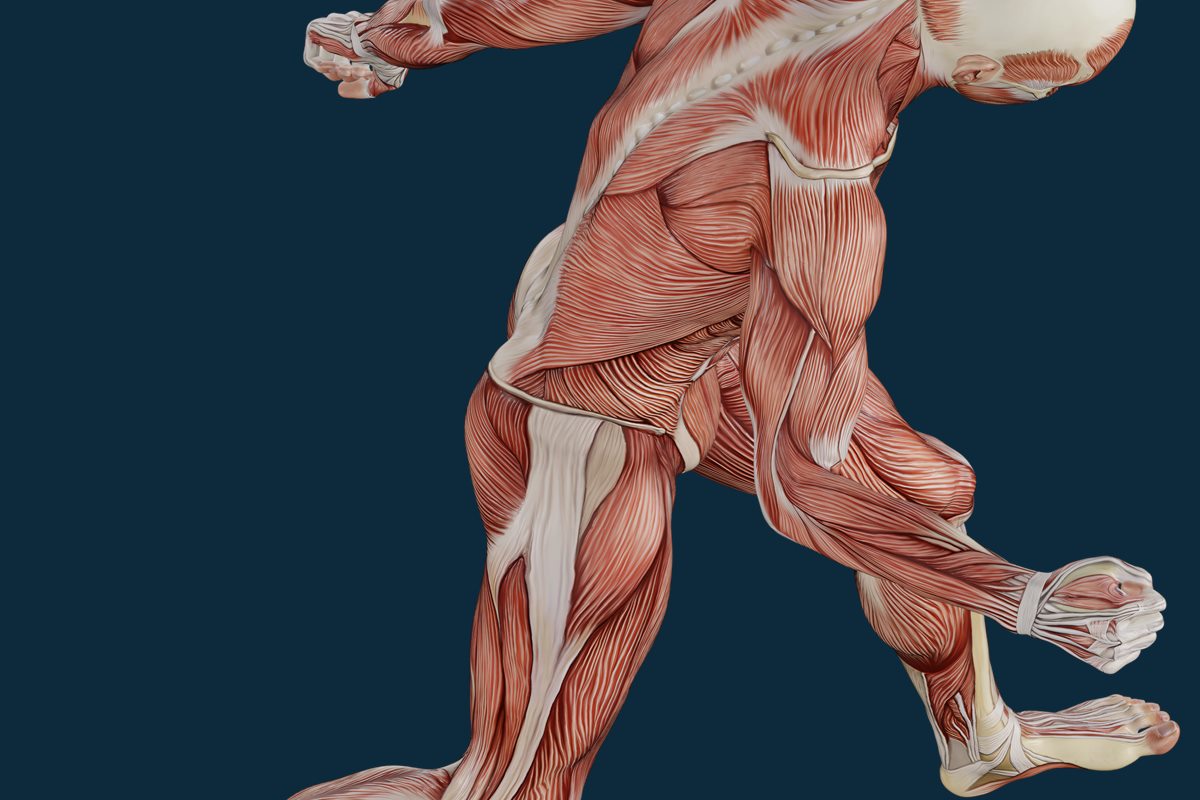
A running stride: the glute drives you forward while the hamstrings decelerate the shin. This is where overload builds up in runners most often.
- Glutes (mm. glutei)
- Hamstrings (mm. ischiocrurales)
- Gastrocnemius (m. gastrocnemius)
- Achilles tendon (tendo calcaneus)
A day after unaccustomed effort a muscle turns tight, sore under pressure and sore on stretch, and by the second day a flight of stairs going down becomes an exercise in its own right. This is delayed onset muscle soreness, DOMS. Massage does work on it, but not in the way sports folklore promises: it noticeably changes how you feel, and barely changes what a dynamometer reads. The gap between those two things is what this whole article is about.
DOMS: what it actually is, and why it is not lactic acid
The scenario is a familiar one. Someone gets to the gym for the first time in six months and does lunges. Or runs their usual ten kilometres, but over hills, with a long descent in the middle. Or helps a friend move house and spends three hours lowering boxes rather than lifting them. During the work everything feels fine, in the evening there is ordinary tiredness, and only twelve to twenty-four hours later it arrives: a dull, spread-out soreness, the muscle dense, tender to the touch, range of motion smaller than usual. The peak is on day two; by day three or four it lets go.
The common denominator in all three stories is eccentric work: the muscle resists a load while lengthening. Walking downhill, lowering the bar, braking a stride, going down steps. In that kind of work the tension falls on a smaller number of active units, and some of the contractile structures take mechanical microdamage. An inflammatory response and swelling follow, and with them a rise in the sensitivity of pain endings in the fascia and the muscle sheaths. That is why it hurts less “deep inside” than it does under pressure and on stretch, and why it hurts with a delay: those reactions need time to unfold.
Lactic acid has almost nothing to do with any of it, even though the phrase “the waste products have clogged up” has lived in changing rooms for decades. Lactate is a working fuel, not rubbish; its concentration returns to baseline within tens of minutes, long before any pain appears. The logic is easy to test: a stationary bike or a climb uphill is almost pure concentric work — plenty of lactate, and usually no soreness the next day. Coming back down that same hill produces little lactate, and aches for two days afterwards. Lactate peaks during the work itself; the pain peaks a day or two later.
A second observation worth keeping in mind: the very same session a week later will hurt far less, and two weeks later almost not at all. Tissue adapts quickly, and this is known as the repeated bout effect. Which leads to something important for anyone used to measuring a workout by how much it hurts afterwards: soreness is a marker of how unfamiliar the load was, not of how good it was. If nothing hurts in week three of a programme, you have not started training worse.
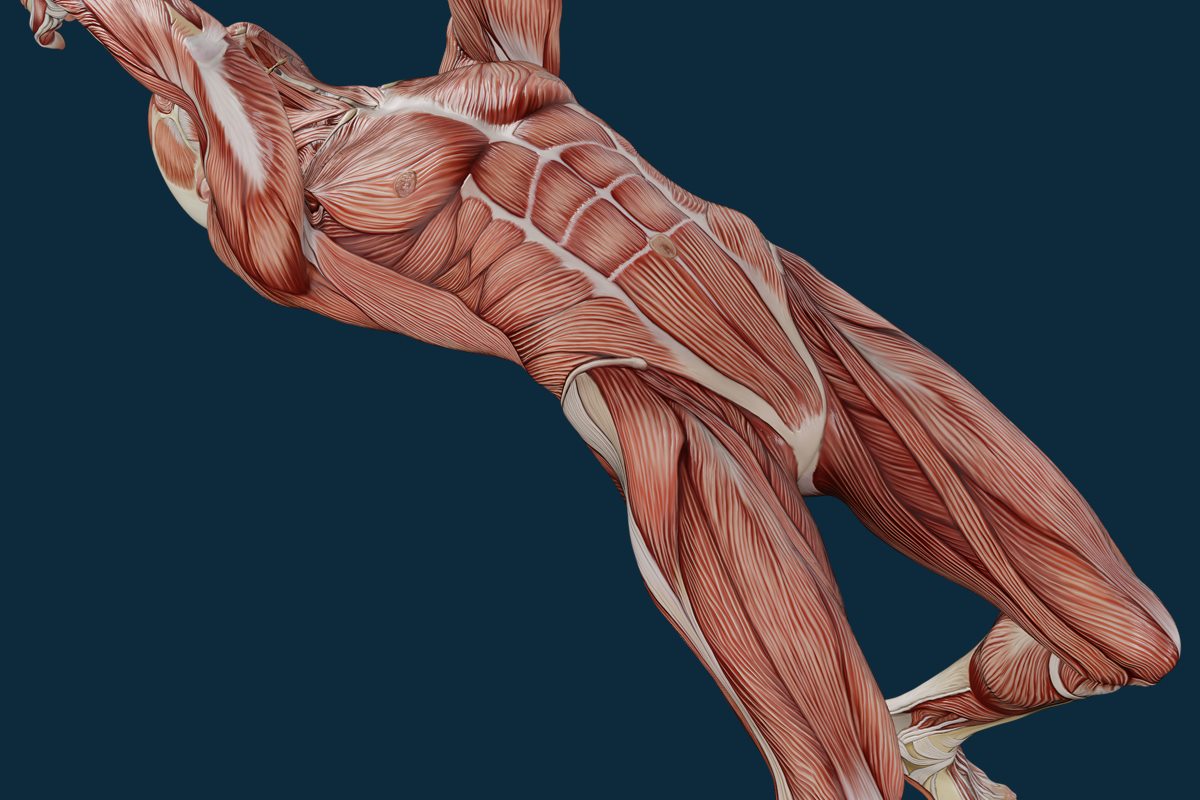
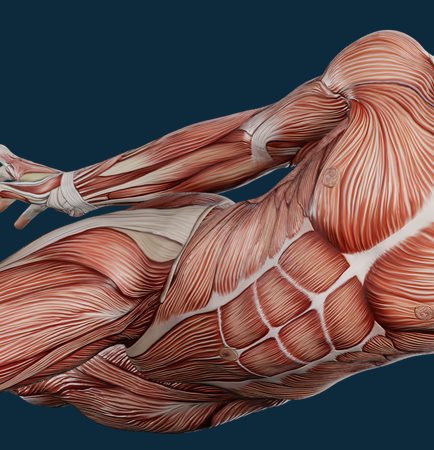
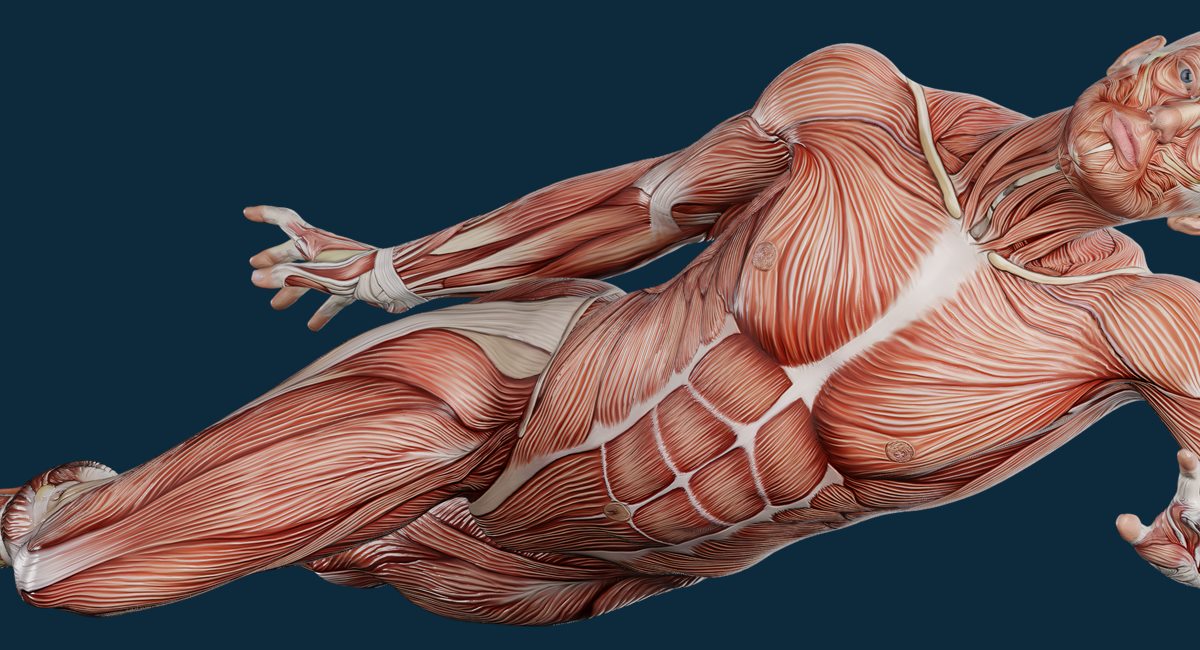
Front three-quarter view: pectoralis major (m. pectoralis major), rectus abdominis (m. rectus abdominis), the external oblique, the quadriceps (m. quadriceps femoris) and the biceps brachii (m. biceps brachii). The classic victim of a long descent is precisely the quadriceps: it brakes your body weight while lengthening under load, and the soreness turns up a day later, not because of “acid”.
- Pectoralis major (m. pectoralis major)
- Rectus abdominis (m. rectus abdominis)
- External oblique (m. obliquus externus abdominis)
- Quadriceps (m. quadriceps femoris)
- Biceps brachii (m. biceps brachii)
What the research says: soreness yes, strength almost never
Massage and DOMS are a rare case where there is a great deal of research and the conclusion is boring and stable. The review literature converges on roughly one point: massage after exercise produces a moderate reduction in perceived soreness in the window from 24 to 72 hours. It repeats across different protocols and different groups — the effect is not enormous, but it is real, and it is more than nothing.
With function the picture is far more modest. Strength, jump height, power output — here the effect is weak, inconsistent and often indistinguishable from zero. After a session you feel easier, you move more freely and you wince less on palpation, but you will squat exactly as much as you would have squatted without the massage. Biochemical markers of damage sometimes look slightly better, yet that is a laboratory number which translates poorly into “tomorrow I will be able to train”.
And now the honest caveats, without which these findings are easy to twist in either direction. The samples are small, and more often students than trained athletes. You cannot blind a participant: a person knows they were given a massage, and expectation on its own lowers a pain rating — that cannot be credited to the technique. Protocols vary: five minutes on one muscle and twenty minutes over the whole posterior chain end up inside the same summary conclusion. So the correct wording sounds like this: massage reliably improves how soreness feels, and is not a way to speed up healing in the tissue.

Massage does not take a day off your soreness. It makes those two days bearable and gives you your normal range of motion back sooner than a pause alone would. Promising more is selling something the hands do not have.
Ale
Why the subjective effect appears at all is a question that has not been fully settled. The most plausible account involves the nervous system: pressure and passive movement change the flow of signals from receptors in the skin, the fascia and the muscle, and the brain rates the same area as less painful. Add a drop in overall arousal — a person lying quietly for an hour, breathing evenly — and that already explains the results well enough. The “driving the blood through and washing out metabolic waste” version tests badly, and I do not use it.
Timing: before the start, straight after, 24-48 hours later
The same massage in different windows produces a different result — sometimes the opposite one. This is the most practical part of the subject, because here the choice depends not on technique but on the date in the calendar.
Recovery
Muscle soreness by the hour
The line is the typical course of delayed soreness after unaccustomed effort; the band around it is the spread between people and loads. The coloured windows show what fits at each moment. Hover over a window or pick one below.
Soreness
onset: 12–24 h
peak: 24–72 h
easing by day 3–4
- Typical course
- Spread between people and loads
hours after the effort →
Windows for massage
424–48 hThe best window
- Pressure
- Working, 6–7 out of 10
- What fits
- The main session: moderate depth, slow strokes, range of motion checked before and after.
- What it gives you
- This is where soreness drops most noticeably and movement comes back. If you have one slot in the week, put it here. On a muscle that already hurts, depth is limited anyway: the threshold has shifted.
Why not deep the day before a race
Deep work is a load in itself: the next day you may get tenderness to pressure, “borrowed legs”, a slightly altered sense of where your limbs are. So the deep session goes 5–7 days before the date, and the day before is left for something short, light and familiar.
- Deep 6 days out: the tissue response is over before the race
- Deep the day before: the response lands on race day
days to the race →
A diagram, not a measurement. The shape of the curve is qualitative. Timings follow this article and the review by Cheung, Hume and Maxwell (Sports Medicine, 2003): soreness arrives 12–24 hours after the effort, peaks at 24–72 hours, eases from the third or fourth day and is fully gone by day 5–7; for any one person they shift with the load, training history and sleep. The windows come from the table and the protocol in this article.
| Window | What fits | Pressure | What it gives you |
|---|---|---|---|
| 30-60 minutes before the effort | Short rhythmic work with movement, 10-15 minutes | Superficial, stimulating | Priming and warm-up; almost no effect on the soreness that comes tomorrow |
| Straight after, 0-2 hours | Gentle work along the loaded chain, no hunting for sore spots | Light, gliding | Less of that tight feeling the same evening; the tissue is already irritated, depth is not needed |
| 24-48 hours later, peak soreness | The main session: moderate depth, slow strokes, range of motion checked | Working, 6-7 out of 10 | The best window: soreness drops noticeably, movement comes back |
| 72 hours and beyond | A full deep tissue session, trigger point work | Full working pressure | No longer about soreness, but about accumulated overload |
Two rules are worth taking away from the table. First: straight after hard work, depth does not help — it adds irritation to tissue that is already irritated; what belongs here is a short gentle session and a walk, not “really press everything out of me”. Second: if there is exactly one slot in your week, put it on the second day after the key session. That is where the difference between “it hurts and will not bend” and “it hurts, but I am moving” is felt most clearly.
Why a deep massage the day before a race is a bad idea
Deep tissue work is a load in its own right. Slow sustained pressure at 6-7 out of 10 along the hamstrings, the calf (m. gastrocnemius) and the glutes produces a response that partly resembles a training response: the next day there may be tenderness under pressure, a sense of borrowed legs, slightly altered proprioception — your feel for where a limb is in space. In an ordinary week none of that gets in the way. The day before a start or a game it is exactly what you do not want.
Hence a rule I repeat to everyone who competes: in race week we try nothing new. A new practitioner, a new technique, a new depth, a new video from the internet, a new ointment — all of it moves to afterwards. The deep session goes five to seven days before the date, and the day before, only what the body already knows is left: short, light, familiar work of about twenty minutes, with no hunting for sore spots and no “while I am lying here anyway, let us finish off that spot”.
The same holds for a first visit in general. If tomorrow brings a long flight, a wedding or a day on your feet, it is better not to book a first deep session the evening before: we do not yet know how exactly you respond. A normal reaction to a first deep session is mild soreness over the following day, much like after training, and the day you need to be at your best is not the day to find that out.
A protocol for the week: the runner and the gym
What follows is a working scheme, not a dogma. The point of it is simple: keep the day of the key load and the day of deep work well apart, and put the session in the window where soreness peaks.
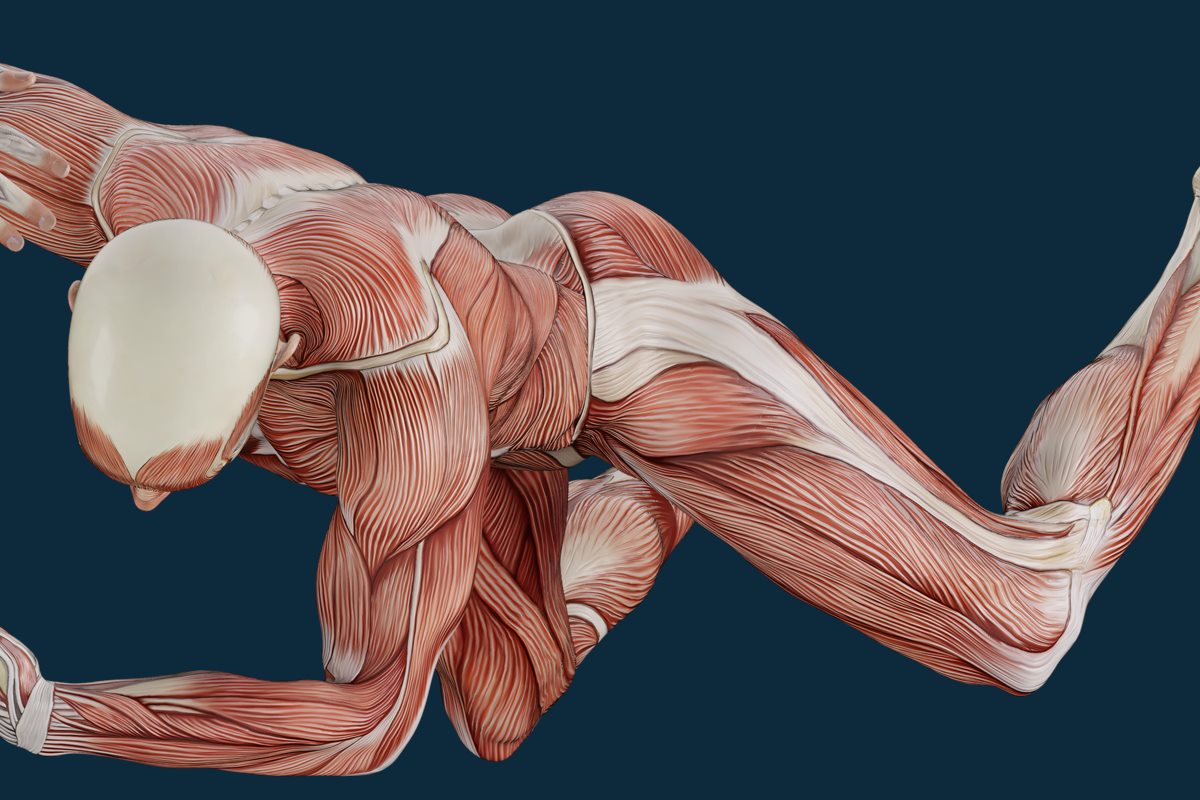
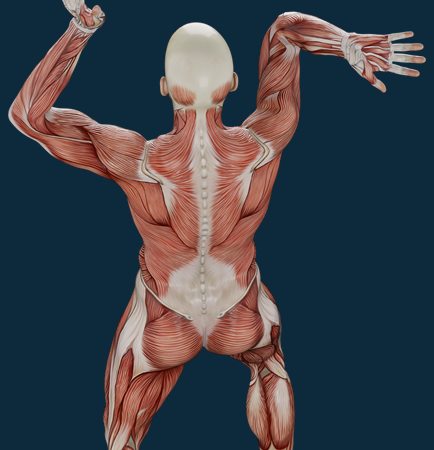
The posterior chain as a whole: latissimus dorsi (m. latissimus dorsi), the glutes (mm. glutei) and the hamstrings. After a long hilly run the soreness is usually spread out exactly like this — not one point but the entire line from the lower back downwards, which is why the work follows the chain rather than “the sorest place”.
- Latissimus dorsi (m. latissimus dorsi)
- Glutes (mm. glutei)
- Hamstrings (mm. ischiocrurales)
The runner
- Saturday, the key session. Long or tempo. That evening: a shower, food, a walk, sleep. Massage is optional, and certainly not a deep one.
- Sunday, easy day. An easy jog, a walk or the pool. If you really want a session, keep it gentle and short: we are taking off the tight feeling, not looking for where it hurts most.
- Monday, about 48 hours after Saturday. The main session: hamstrings, calves, glutes, the erector spinae. Moderate depth, a slow pace, range of motion checked before and after.
- Wednesday, intervals. Legs should arrive at speed work feeling collected, so we do not schedule a deep session the day before intervals.
- Race on Sunday. All deep work is closed off by Tuesday or Wednesday. After that, only short light sessions of the kind you have already been through.
The gym
- Legs on Monday means no leg massage an hour after squats — Tuesday evening or Wednesday instead. The hour after a heavy squat session is the worst possible time for deep work on the quadriceps.
- Keep upper and lower body apart. If legs are on Monday and back and shoulders on Thursday, put the upper body session on Saturday, not on pulling day.
- The first week of a new programme gives you soreness everywhere at once. One general moderate session is more useful here than a targeted hunt for the sorest muscle.
- The one-change rule. Do not raise your training volume and add a new manual technique in the same week — otherwise there is no telling what helped and what overloaded you.
A separate word on pressure, because it is the main source of misunderstanding. The working range of discomfort is 6-7 out of 10: clearly felt, you can tell the muscle is being worked, but your breathing stays even. The criterion is simple: if you can breathe, the pressure is right. The moment you hold your breath and the muscle under the hand tightens to guard itself, the pressure is excessive, and there is nothing useful in it. “Bear with it and I will loosen it up” is not a method, it is a way of buying yourself another day of soreness. On a muscle that is already sore from DOMS, depth is limited by definition: the threshold has shifted.
Sleep and food: the base without which the rest is cosmetic
If you line up everything you can do about soreness in order of how much it matters, sleep comes first by a wide margin — ahead of massage included. Going short on sleep raises pain sensitivity: the same microdamage on five hours of sleep feels appreciably worse than it does on eight. This is not about willpower, it is a shift in threshold. In practice it looks like this: a client arrives with “unbearable” soreness after an ordinary workout, and in conversation it emerges that behind them lie three nights of five hours and a flight. Hands will help, but the effect will be shorter than usual, and it is fairer to say so up front.
Nutrition comes second. Repairing tissue takes material and energy: protein spread across your meals through the day, and a calorie intake that is not sitting in a deep deficit, affect how fast you come back to normal more than any manual technique does. These are not dietary prescriptions — for those, see the relevant specialist — but a reminder: you cannot undereat and undersleep and then expect structural change from an hour on the table.
About water I will be direct. You need it, but not because it “flushes” something out of the muscles: there are no such processes in tissue, and massage removes no “toxins” of any kind. A dehydrated person simply tolerates pressure less well and more often reports feeling sluggish after a session. A glass of water before and after is about how you feel, not about biochemistry.
And the last thing that is regularly underrated: movement. Complete rest during a bout of soreness stretches out the unpleasant period, while light activity — a walk, an easy ride, whatever range of motion you have without pain — reduces the tight feeling the same day. The mechanism is the same as with massage: a gentle load changes how the area feels without directly speeding up healing. Massage sits well on exactly that kind of week: sleep, food, easy movement and one moderate session on the second day. Without that base it turns into a pleasant hour, after which everything is back by the evening.
Share:
More articles